
Food & Agriculture
In the current era of macro volatility, the conversation around our global food and agriculture system is shifting. It’s moving away from a narrative of scarcity and risk and toward one of resilience, industrial stability and long-term economic opportunity.
For the market builders and allocators among us, it is increasingly clear that sustainable, systems-focused agricultural investing will yield positive change and financial returns for investors, companies and farmers alike.
That’s why Builders Vision—along with our partner S2G Investments—hosted a conversation centered around this important topic. As investors focus on scaling the agriculture transition, we know that bridging the gap between early-stage innovation and institutional scale requires bringing the right people to the table. As Lukas Walton, Founder and Executive Chairman of Builders Vision, welcomed the group, it was clear the room was intentional, featuring a curated group of global leaders from across the entire value chain—from institutional investors and C-suite executives to early-stage investors and farmers.
The goal was simple but ambitious: move beyond the “why” and get straight to the “how.” How do we build an investable asset class that treats soil health as a foundation for financial durability? How do we scale the infrastructure needed to bridge the gap between a regenerative farm and a global consumer? And ultimately, how does sustainable agriculture fit into a resilient investment portfolio in times of economic uncertainty?
To kick off the discussion, Builders Vision Chief Investment Officer Noelle Laing moderated a fireside chat with Matt Harris, Founder of Bedari Collective and Founding Partner and Senior Managing Director at Global Infrastructure Partners. As Harris drew on his experience building one of the world’s leading infrastructure investment firms, he highlighted what sustainable agriculture can learn from that journey–how offtakers, lenders and rating agencies had to come together to make infrastructure investable at scale.
In the early 2000s, many questioned if energy, transportation and water were truly “investable” sectors for institutional capital. Today, they’re foundational to every major portfolio. That opens up a powerful parallel: sustainable agriculture is at that same precipice. To cross it, we must demonstrate the same value chain characteristics: duration, non-replicability and recurring cash flows.
Nearly every topic returned to one core theme: the farmer must be at the center of this transition. While much of today’s investor dialogue focuses on how to incentivize adoption, there was agreement that farmers are already deeply committed to the health of their land, but they need practical solutions that meet them where they are.
For farmers in the room, the shift to more sustainable practices is not only about environmental stewardship but also about risk management and long-term resilience. Practices that improve soil health, reduce input costs and help stabilize yields through increasingly volatile weather patterns are attractive to innovative farmers. Yet, as one farmer noted, “Boardroom ideas don’t always transfer to the farm.”
That disconnect underscored a broader point: investors need to spend more time on the farm to understand operational realities and align expectations with what actually drives adoption and profitability. Successful investment strategies in agriculture must begin with recognizing that the application of regenerative agriculture practices is highly location-specific, driven by each farm’s crop, soil type and region.
It is imperative to focus on feasibility and farm economics—ultimately what impacts the farmer’s bottom line. Access to better data and tools to help demonstrate how regenerative agriculture practices translate to higher asset value and more resilient income streams will help influence adoption.
A recurring theme throughout the discussion was that sustainable agriculture cannot be viewed through a single asset class lens.
Because the transition requires a systems approach where different forms of capital play distinct roles at different stages of scale, no single investor or strategy can drive it alone. Scaling the sector requires coordinated investment across the capital spectrum to accelerate adoption. This includes:
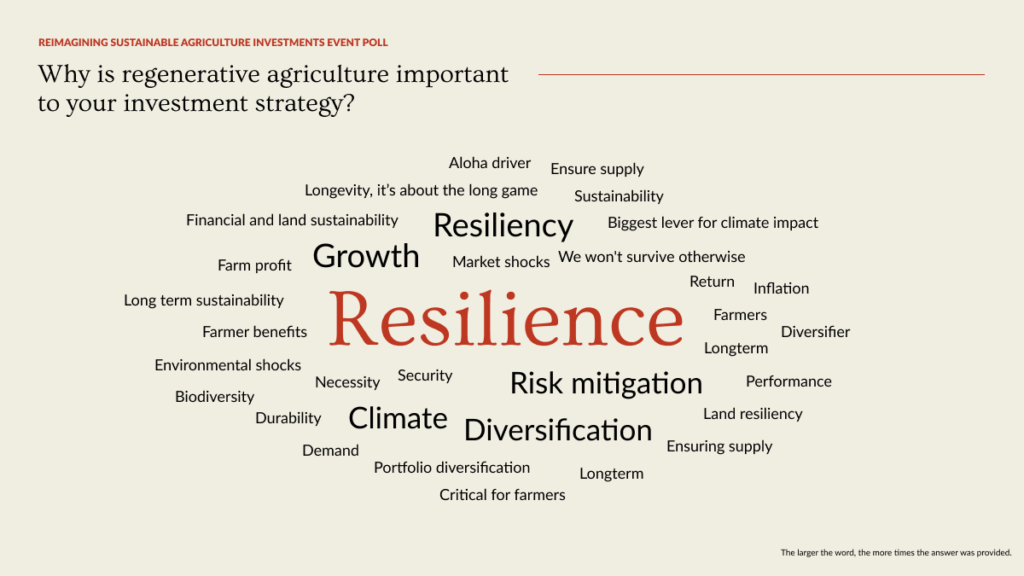
This convening was about committing to action. Despite representing different corners of the industry, a shared motivation drove the room: the urgent need to build a resilient food and agriculture system capable of withstanding market and environmental shocks.
This new era of macro volatility has highlighted an immense opportunity for those willing to lead. In many ways, this moment in time marks a shift into what participants described as “Regen 2.0″—moving beyond early-stage proof of concept and into the phase of active scaling.
This exciting conversation continues. If you are conducting research, considering new investments, have market-building philanthropic efforts or are interested in learning more, we invite you to reach out! Continue to visit our website and LinkedIn for more insights into our food & agriculture, energy and oceans investments.